A Little Girl in the Cloud with Moon: Embroidery Design Review
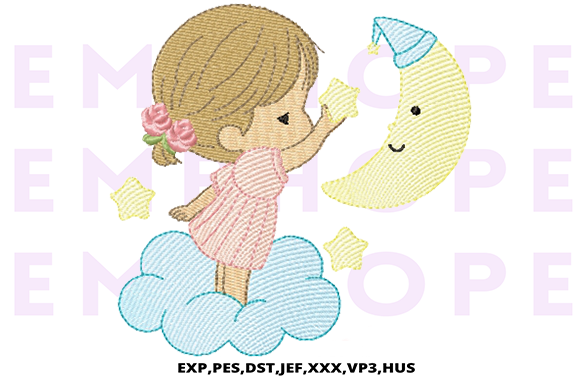
When I first opened the file for A Little Girl in the Cloud with Moon, I immediately recognized a design that carries a gentle, storybook charm. The combination of a sleepy moon and a small girl nestled in a cloud feels both playful and timeless. From a small business perspective, this machine embroidery design lands squarely in that cozy, dreamlike category—perfect for brands that want to project warmth, innocence, or a handmade heart. The description calls it “playful and adorable,” and I fully agree. The visual rhythm is whimsical but not chaotic, which matters a lot when you are translating a digital embroidery file onto textured fabric or curved surfaces like caps and tote bags.
Originally listed under the Bed category, A Little Girl in the Cloud with Moon suggests it may have been intended for pillows, blankets, or nursery décor. But my job as an embroidery designer working with small businesses is to see beyond a single use. A design like this can easily migrate from bedding onto branded merchandise, staff uniforms, or promotional patches. The key is evaluating its performance not just as a pretty picture, but as a reliable commercial embroidery asset.
First Impressions and Visual Personality
The composition is soft and round, dominated by curved lines that naturally suit the embroidered patch format. There is a clear focal point—the little girl’s face or the moon—that draws the eye. For a brand identity built around comfort, childlike wonder, or gentle aesthetics, this design is a strong contender. I could see a small café using it on apron embroidery, a boutique children’s clothing line adding it to chest logo accents, or a handmade soap maker turning it into a signature patch on linen gift bags.
The title itself—A Little Girl in the Cloud with Moon—tells a story. That narrative quality is a massive asset for small business merch. Customers don’t just buy a product; they buy a feeling. This design delivers a consistent feeling of safety, dreams, and sweetness. As an embroidery file, it’s likely to perform best when the thread colors stay pastel or subdued, though I always test a black and white version first to see how the contrast holds up on different backgrounds.
Business Applications for Small Brands
When I consult for Etsy sellers, craft businesses, or local studios, I always ask: Where do you want your logo or signature motif to live? A Little Girl in the Cloud with Moon works across a surprisingly wide range of touchpoints.
- Embroidered patches: This is the most obvious and profitable use. A well-digitized patch can be sewn onto denim jackets, canvas pouches, or backpacks. The design’s soft edges and cloud shape are forgiving and require minimal trimming.
- Apron embroidery for bakeries or florists: Picture a dusty pink apron with this design stitched near the heart or on a pocket.
- Cap embroidery: With careful resizing, this can work on unstructured caps, especially for children’s brands or family-oriented businesses.
- Tote bag design: A larger version on a natural cotton tote becomes an instant gift with purchase.
- Staff uniforms: For a daycare, pediatric clinic, or toy store, this design adds a friendly, approachable accent without feeling corporate.
- Product packaging accents: Small embroidery on fabric bags that hold artisan tea, candles, or organic baby products can elevate your whole brand.
- Custom apparel: Think sleepwear sets, baby onesies, or even soft sweatshirts for a loungewear line.
I would not hesitate to use A Little Girl in the Cloud with Moon as part of a cohesive set of design assets for a launch. When you build a collection around a central motif—say, moon phases, sleepy clouds, stars—this piece acts as the hero. The consistent visual consistency across products helps customers recognize your brand identity instantly, whether they see it on a patch, a tote, or a printable mockup on your Etsy listing.
Design Considerations and Technical Cautions
As much as I like the visual concept, there are practical limits every embroiderer should test before committing to a bulk order of finished product.
Small patch sizes: This is where many adorable designs fail. The girl’s facial features, the moon’s craters, or tiny cloud wisps might close up if stitch density is too high. I recommend running a test stitch at the intended patch size—especially if you plan to use it on cap fronts, which often demand a smaller footprint. If details become muddy at 2 inches or less, you may need to simplify or enlarge.
Curved surfaces: Cap embroidery already pushes digitizing limits. The rounded cloud body could distort if not positioned correctly. Always do a sew-out on a real hat, not just flat fabric, to check registration.
Thread color contrast: The description implies a delicate feel, but pale thread on a light fabric will vanish. Test on dark denim, black totes, or rich uniform shirts to see if the moon and the girl’s silhouette pop. Sometimes a subtle outline or a darker background layer inside the cloud solves the problem without ruining the playful mood.
Fabric texture: A high-loop terry cloth towel or a chunky knit beanie will eat delicate stitches. On these items, use a heavy water-soluble topping and the right stabilizer to keep the design crisp. Frequent washing—something you must expect for uniforms or baby goods—demands a tightly locked satin stitch and careful underlay.
Hoop size and file details: The product description doesn’t specify exact hoop size, stitch density, or supported formats, and it cuts off mid-sentence with “Please note that the quality can n.” This is a red flag I always highlight for business buyers. Before purchasing any digital embroidery file, confirm the file type your machine accepts, the default hoop dimensions, and whether the design includes a color sequence chart. Ask the seller for a clear, finished photo of a sew-out, not just a digital rendering. That level of due diligence saves wasted blanks and late-night frustration.
Brand Identity and Customer Perception
Every stitch on your merchandise tells a story about your brand identity. A Little Girl in the Cloud with Moon leans heavily into a handmade, gentle, and nostalgic aesthetic. For a bakery specializing in birthday cakes, a children’s bookshop, or a sustainable baby brand, this design reinforces trust and emotional connection. It signals “we care about the small things,” which translates directly into higher perceived value for your product.
On the flip side, if your brand is edgy, tech-focused, or industrial, this design will conflict with your message. I often see small businesses try to force a cute element into a modern brand, and it confuses buyers. The design must align with your customer’s expectations from the first glance. When it does, buyer engagement rises—people will photograph that embroidered patch or cap embroidery and share it, becoming walking ads for your small business merch.
For handmade product sellers, the presence of a consistent, professionally digitized embroidery file elevates your booth or online shop from hobbyist to legitimate brand. Even when applied subtly—like a small accent on a sleeve or a corner of a tote bag—it adds that professionalism and polish that justifies premium pricing.
Embroidery Designer Notes and Best Practices
As someone who has stitched thousands of designs on everything from silk ties to thick canvas, I follow a set of rules before greenlighting any design for a client’s commercial run. Here’s what I recommend for A Little Girl in the Cloud with Moon:
- Test in black and white first. Convert the design image to grayscale to check contrast. If the girl and moon blend together, thread color planning becomes critical. This also helps you anticipate how the design will read on light versus dark uniforms.
- Check small patch performance. Stitch it at 2 inches, 2.5 inches, and 3 inches. I often find that adding a slight underlay and reducing stitch density by 10–15% keeps the fabric from puckering while protecting the delicate expression of the girl’s face.
- Review thread color contrast. If you’re using a pastel palette, consider a dark outline or a contrasting cloud shadow to make the design pop on a white apron or a natural linen tote.
- Inspect spacing. Look for tiny gaps between the cloud, the girl, and the moon. Too much space filler causes thread bunching; too little and elements bleed together. Run a sew-out and measure with a seam gauge if needed.
- Confirm hoop size. Don’t assume. Measure the actual design dimensions from the file and verify they fit your most commonly used hoops. If the design needs a larger hoop than you stock, it could disrupt your production flow.
- Use proper stabilizer and test on real fabric. A tote bag design on canvas needs a different backing than an apron embroidery on twill. Cutaway stabilizer for knits, tear-away for woven, and always test on the exact fabric you’ll sell.
- Create a mockup for client approval. Before you stitch, generate a printable mockup or digital mockup showing the design on the actual product. This sets the right expectation and often leads to faster buy-in.
- Compare beside other design assets. If this is part of a collection, sew it next to a companion design. Check that line weights, thread sheen, and design scale feel consistent across the entire branded merchandise line.
- Confirm commercial licensing before business use. The description does not explicitly state whether A Little Girl in the Cloud with Moon is licensed for commercial use on items you sell. This is non-negotiable for commercial embroidery. Ask the creator directly: Can I use this embroidery file on products I sell? Are there any limits on quantity or type of goods? Get it in writing.
One thing I love doing is pulling a design like this into a sample kit for pop-up events. A pocket-sized embroidered patch of A Little Girl in the Cloud with Moon can be a freebie with purchase, a loyalty stamp card holder, or a collectible. The reaction is almost always a soft smile from customers—that emotional hook is priceless marketing.
Final Thoughts on Commercial Use
A Little Girl in the Cloud with Moon has the bones of a profitable, endearing design that can work across multiple product lines. Its playful nature, simple shapes, and strong storytelling ability make it a smart addition to any custom apparel or branded patch arsenal, provided you do your technical homework. The incomplete description is a minor friction; serious embroiderers will quickly fill those gaps with a message to the seller and a test sew-out.
For the boutique owner dreaming of a signature look, the baker wanting a whimsical staff apron, or the Etsy crafter building a cohesive patch collection, this design can carry its weight. It sits comfortably at the intersection of adorable and professional—if you treat it as a true business asset and not just a cute picture. Test it, tailor it to your brand identity, and you may find that a Little Girl in the Cloud with Moon becomes the silent salesperson your products have been missing.